The Room Where It Happens
At first, it seemed like a dream. No commute. No office politics. Just you, your coffee, and your work.
But months later, something shifted. The same four walls that felt like freedom started feeling like a cage. The convenience of rolling out of bed to your desk became the inability to ever really "leave work." And the peace and quiet? It started to feel more like silence.
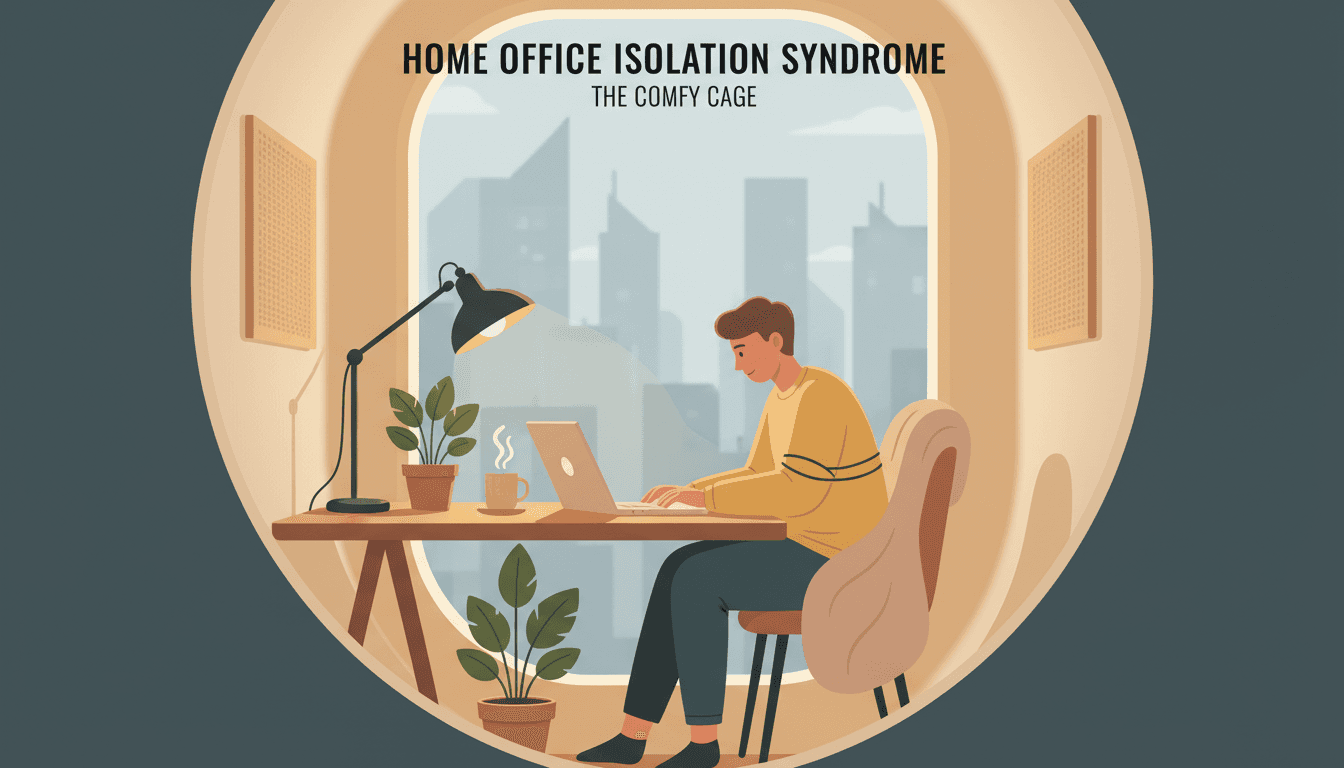
Welcome to Home Office Isolation Syndrome - a growing mental health concern that researchers are increasingly recognizing as a distinct psychological phenomenon affecting millions of home-based workers worldwide.
A 2024 study from the American Psychological Association found that home office workers experience a unique form of isolation that differs from both traditional loneliness and typical workplace stress. It's characterized by the blurring of all life boundaries - work, rest, social, personal - into a single, oppressive space.
The New Normal That Isn't Normal
The statistics paint a concerning picture of the home office mental health crisis:
- 47% of home workers feel lonely always or often (Buffer State of Remote Work 2024)
- 63.1% experience high levels of emotional exhaustion (Journal of Occupational Health)
- 81% of remote workers report increased workplace stress
- 46% feel disconnected from their jobs and colleagues
- The average remote worker goes 2-3 days without meaningful non-work conversation
- 60% report difficulty separating work and personal life
- 76% say home-based loneliness has negatively impacted their mental health
- 52% have experienced symptoms of depression since working from home
These aren't just numbers - they're people. Perhaps they're you.
The Psychology of Space
Our brains evolved to associate different locations with different activities. Home meant safety, rest, and family. The office meant work. This separation served a crucial psychological function.
When home becomes work, several things break down:
- Contextual cues disappear: Your brain no longer knows when to "switch off"
- Recovery becomes impossible: You can't recover from work stress when you're still "at work"
- Rituals vanish: The commute, however frustrating, provided a transition zone
- Boundaries blur: Work emails at dinner, personal calls during meetings - everything merges
Research from the University of Michigan found that people who work from home show elevated cortisol levels throughout the day, compared to office workers whose stress hormones follow a healthy declining pattern after leaving work.
The Invisible Symptoms
Home office isolation doesn't announce itself. It creeps in quietly, often unrecognized until it's severe:
Behavioral changes:
- Talking to yourself more than you realize (and not in a healthy, processing way)
- Overworking because there's nothing else to do - and no one to notice you're still working
- Difficulty with small talk when you do see people - social muscles atrophy
- Dread about leaving the house for once-simple errands
- Avoiding video calls because "being on" feels exhausting
Emotional symptoms:
- Emotional flatness - neither happy nor sad, just... nothing
- Irritability at minor disruptions to your routine
- Feeling invisible - like you could disappear and no one would notice
- Guilt about not being more productive despite all your "free time"
Coping mechanisms:
- Over-reliance on pets for companionship (pets can help, but they can't converse)
- Binge-watching to fill the silence
- Doom-scrolling social media for parasocial connection
- Increased alcohol consumption - home offices have easy access to the fridge
The Four Walls Problem
Your home was designed for living, not for 8-10 hours of daily work. When you never leave, a phenomenon psychologists call "place attachment disruption" occurs:
- Every room becomes associated with work stress
- Physical boundaries between work and rest disappear
- Social skills atrophy from disuse
- Depression and anxiety find fertile ground
- Your world shrinks to the size of your apartment
- Agoraphobic tendencies can develop - the outside world feels overwhelming
- Time loses meaning - was that meeting today or three days ago?
A study published in the Journal of Environmental Psychology found that people who work from home for extended periods report decreased satisfaction with their homes - the very place that was supposed to feel like a refuge.
The Partner Paradox
Even those living with partners or family aren't immune to home office isolation:
- Your partner is also working or busy with their own life
- Quality time is harder to find when you're "always together" but never truly present
- Over-familiarity can strain relationships - you see each other at your worst, constantly
- Outside perspectives become rare - you become each other's only social outlet
- You may feel guilty for needing "more" when you "have someone"
- Relationship stress increases when home becomes everyone's workplace
Research shows that couples where both partners work from home report higher rates of conflict and lower relationship satisfaction compared to couples with at least one office-based worker.
The Mental Health Cascade
Home office isolation doesn't stay isolated - it cascades into broader mental health issues:
- Loneliness leads to sleep disruption
- Poor sleep leads to reduced cognitive function
- Cognitive fog leads to reduced productivity
- Reduced productivity leads to guilt and anxiety
- Anxiety leads to social withdrawal
- Social withdrawal deepens loneliness
This cycle is self-reinforcing. A 2024 meta-analysis found that remote workers who experience loneliness are 3x more likely to develop clinical anxiety or depression within 18 months.
Breaking the Cycle: What Works (and What Doesn't)
Traditional advice that helps somewhat:
- Go to a coffee shop (but this costs money and requires energy)
- Join a coworking space (but monthly fees add up)
- Schedule video calls with friends (but these feel like more "work")
- Get outside more (but it doesn't address the empty hours at home)
What traditional advice misses:
The 24-hour nature of home office loneliness. What about:
- 10 PM when everything's closed and you're still alone?
- The middle of a difficult work day when you need to vent?
- When you don't have the energy to "schedule" socialization?
- The mornings when you need a reason to get out of bed?
- The weekends that blur into workdays?
The problem isn't that we don't know we should be more social. It's that loneliness doesn't follow a schedule.
The Case for Constant Companionship
What home workers often need isn't more scheduled interaction - it's ambient companionship. The feeling that someone is "there":
- Available but not demanding attention
- Present but not intrusive
- Engaging but not exhausting
- Consistent but not boring
- Understanding without requiring explanations
- There at 2 AM when anxiety hits, not just 9-5
This is exactly what AI companions are designed to provide - a bridge between complete isolation and the energy required for human interaction.
Research on AI companionship shows promising results. A 2024 study found that people using AI companions reported:
- 35% reduction in feelings of loneliness
- Better sleep quality due to reduced nighttime anxiety
- Improved mood throughout the day
- More energy for actual human interactions
The key insight: AI companions don't replace human connection - they preserve the energy needed for it.
Reclaiming Your Space (and Your Mind)
If your home office has become a prison, here's what the research suggests:
- Create physical boundaries: If possible, work in only one area - never your bedroom
- Establish rituals: A fake "commute" around the block can help your brain transition
- Seek ambient connection: Background presence matters more than scheduled calls
- Accept help: Whether it's a therapist, friend, or AI companion - you don't have to do this alone
- Monitor your symptoms: Keeping a mood log can help you catch isolation before it becomes severe
You Deserve More Than Survival
If your home office has become a prison, know that:
- You're not ungrateful for wanting more connection - it's a fundamental human need
- It's not laziness to struggle with motivation alone - even extroverts need external structure
- Needing companionship is human, not weakness - we evolved to be social creatures
- The solution doesn't have to involve leaving your house - help can come to you
- It's not your fault - the system was designed for productivity, not humanity
Your productivity matters, but so does your wellbeing. The future of work should include solutions that address both - including companions that understand the unique rhythm of home-based life.
Your home should be your sanctuary, not your cell.